
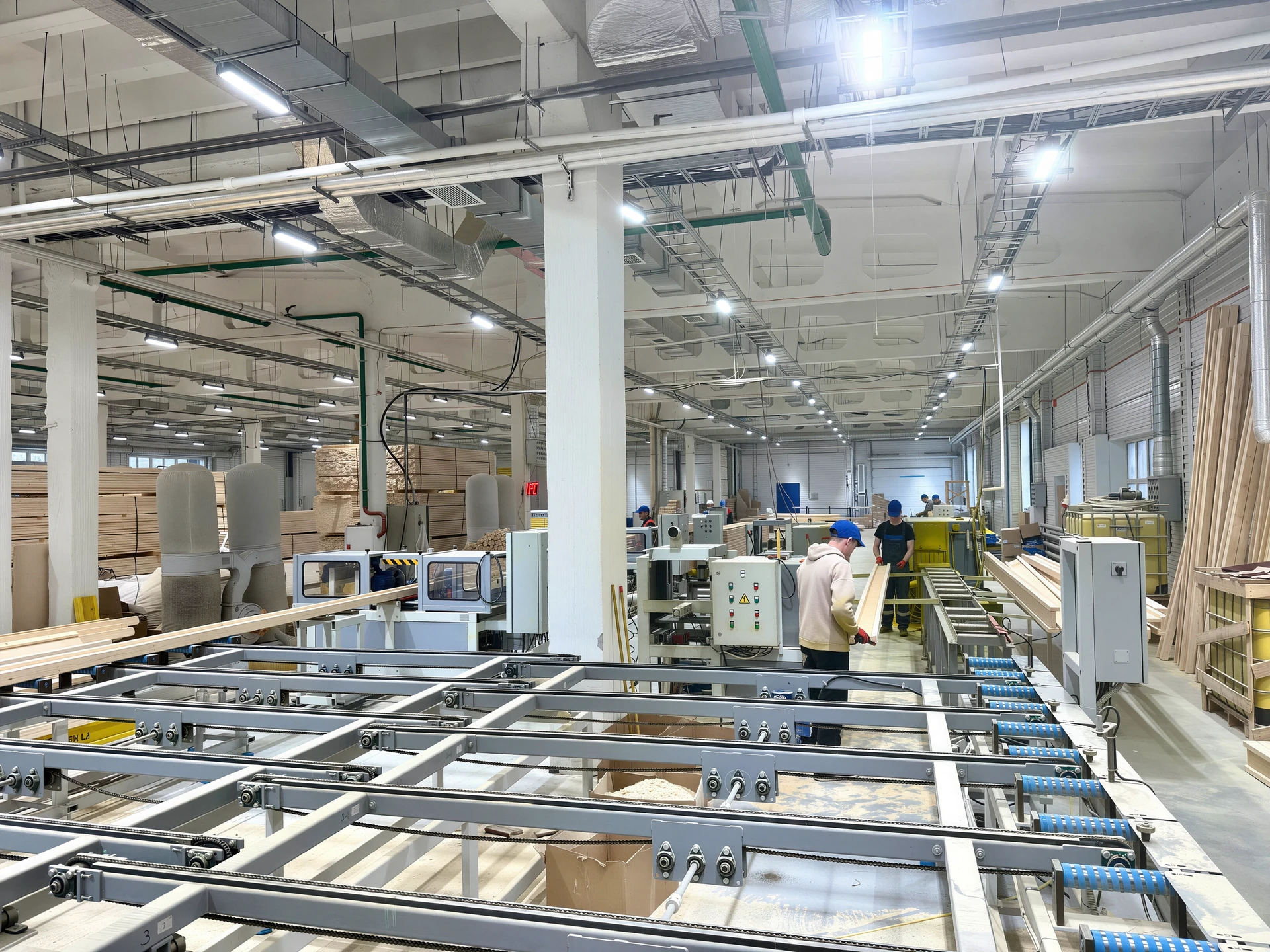
Log sawing
We saw logs on Sherwood 668C and Sherwood 692C chipper-canters.
These machines process small-diameter sawlogs in a single pass using a 2-ex-log sawing pattern.
We process small-diameter softwood sawlogs, spruce and pine, grown in the north of the Republic of Karelia.
This timber has higher density than timber from central Russia. The quality of our raw material gives our products better strength characteristics.
Drying the flanges
Our factory has five drying kilns with a combined capacity of 600 m³.
H20 timber beam manufacture requires timber dried to 12% moisture content. Achieving this is demanding, which is why beams made with flanges dried only to shipping moisture content, 16–18%, can be found on the market.
We do not compromise on this requirement. We prepare our flanges in accordance with European standard DIN EN 13377-2002.
Plywood cutting
We use 24 mm birch plywood from leading Russian manufacturers.
We cut 1525 × 1525 mm plywood sheets on an MSP-1500 multi-rip panel saw made in Russia. The line also includes an automatic vacuum sheet-feeding machine.
Plywood jointing
We use a continuous plywood-jointing line custom-built for our factory by a machinery manufacturer in Vologda. It can bond plywood strips up to 1,600 mm long, reducing the number of joints in the plywood webs of longer beams.
Timber finger-jointing
We finger-joint our timber on a German WEINIG line that can join blanks up to 3,000 mm long. For beams up to and including 3.90 m long, each flange may contain no more than one finger joint; for longer beams, no more than two per flange. Joints are staggered along the beam, preventing the upper flange, plywood web and lower flange joints from all coinciding in a Karelia Premium H20 beam.
Planing the timber and plywood
We plane the timber on a nine-spindle LeaderMac 923 machine from Taiwan.
We plane the plywood on a six-spindle LeaderMac 623 machine from Taiwan.
This high-capacity equipment enables us to achieve precise product geometry.
Beam assembly
Eight machines are involved in beam assembly.
Assembly begins with the application of polyurethane adhesive. A press then applies 6 atmospheres of pressure to the flanges with the plywood web inserted between them.
The assembled beam is then trimmed to its exact length. The ends are milled to accommodate the plastic end caps.
The drilling machine also includes an end-finishing unit to ensure that no chipped edges or burrs remain after milling.
The assembled beam then passes through the coating machine. A printer applies the logo and markings, and plastic end caps are fitted at the end of the process.